Showing posts with label Ancient History. Show all posts

Sunday, May 12, 2019

Ancient Tools Reveal 500,000-Year-Old Migration Routes of Human Ancestors in ‘Cradle of Humanity’

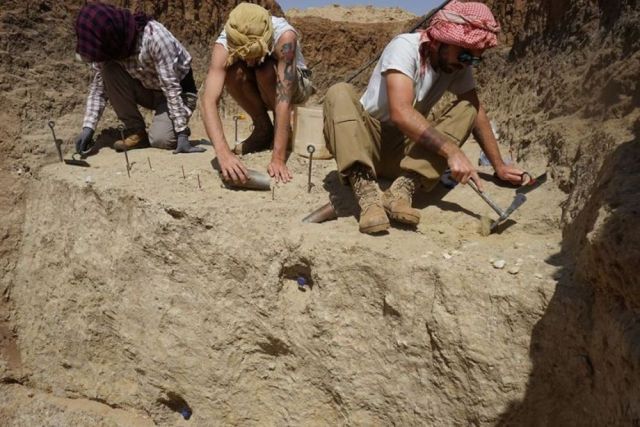
During excavations in Eastern Sudan, the scientists from the Wrocław University’s Institute of Archeology found remnants of the humanoids’ presence which tell the untold story of the different phases of human species migration from half a million years ago.  Instytut Archeologii Uniwersytetu Wrocławskiego/Facebook
A group of Polish archeologists have uncovered sensational proof that Homo Erectus, the ancestor of today’s humans, spread around the globe using previously undiscovered migration routes.
During excavations in Eastern Sudan, the scientists from the Wrocław University’s Institute of Archeology found remnants of the humanoids’ presence which tell the untold story of the different phases of human species migration from half a million years ago.
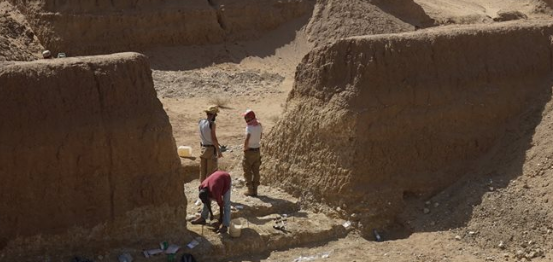
Discoveries in the Eastern Desert also confirm the long coexistence of Homo erectus with Homo sapiens in Africa: it is a period of at least 100,000 years, falling between 300,000 and 200,000 years ago. Both species lived there simultaneously. Instytut Archeologii Uniwersytetu Wrocławskiego/Facebook
The Polish archeologists, together with colleagues from Germany, Saudi Arabia, South Korea, and the United States decided to conduct their research north of the area, which is usually perceived as the cradle of humanity (along the Great Rift Valley, from Mozambique to the Red Sea) – the Eastern Desert in Sudan.
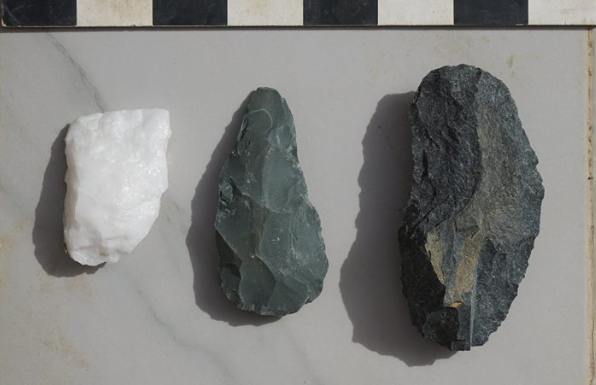
Enticed by the news, that gold miners in the area were uncovering prehistoric tools, the scientist not only confirmed this information but came across a lot more.
Enticed by the news, that gold miners in the area were uncovering prehistoric tools, the scientist not only confirmed this information but came across a lot more. Instytut Archeologii Uniwersytetu Wrocławskiego/Facebook


On March 6th, the archeologists summarized their project on the Institute of Archeology’s Facebook: “We just finished the last season of excavations in Sudan, which are carried out by our Institute in collaboration with Museum of Archaeology in Gdansk and Neelian University in Khartoum.
“This international project entitled ‘Homo erectus on the path to Eurasia…’ is focused on remains of Pleistocene settlement in the Eastern Desert. During this season we excavated four sites which yielded many finds.
“The oldest artifacts, which we found at archaeological site EDAR 7, are dated to 0,5 Ma [500 thousand years ago] and related to early middle Pleistocene Acheulean culture. This is the oldest known archaeological site in NE Africa.”

Homo Erectus migrations from Africa. PAP Infographics/PAP

What they found was that Homo Erectus traveled outside of Africa not only along the Nile river but also through what is now a desert which used to be a humid area with plants and rivers leading to the Red Sea.
Discoveries in the Eastern Desert also confirm the long coexistence of Homo erectus with Homo sapiens in Africa: it is a period of at least 100,000 years, falling between 300,000 and 200,000 years ago. Both species lived there simultaneously, although one gave birth to the other.
The archeologists, led by Wrocław University’s Prof. Mirosław Masojć (pictured), discovered “… an assemblage of artifacts containing, among others, choppers and chopping tools, bifacial tools (hand axes and cleavers) and big flake tools. ”Instytut Archeologii Uniwersytetu Wrocławskiego

The archeologists, led by Wrocław University’s Prof. Mirosław Masojć reveal they discovered “… an assemblage of artifacts containing, among others, choppers and chopping tools, bifacial tools (hand axes and cleavers) and big flake tools.
“Younger finds from the Middle Stone Age, which were manufactured using the Levallois method, can be linked to the settlement of this region by anatomically modern humans (Homo sapiens).
“Every day, we covered 90 kilometers in the desert from our base in Atbara to the sites. In the afternoons, after finishing field work, we devoted ourselves to analyses and recording of our artifacts. Some of the tools were chosen to be transported to Poland, which will allow us to conduct microscopic use-wear analyses.”
We have an affiliate program designed for content creators and Affiliate marketers, who would like to sell this product, please click here for affiliate program details. Our affiliate program is designed to help you monetize your screen time.
Reference:


Friday, May 3, 2019

A First for this Indian Subcontinent, ASI Excavation Leads to Discovery of 'Legged Coffins' (Photos)


by N. Morgan


Members of the Archeological Survey of India (ASI) have discovered two 'legged coffins' during an excavation in Sanauli in Baghpat district of Uttar Pradesh.

New Delhi: In a history-making achievement, the Archeological Survey of India (ASI) has unearthed two decorated 'legged coffins' during an excavation process in Baghpat district of Uttar Pradesh. Officials claim that this is the first of a kind discovery in the Indian subcontinent.


Furnaces, 'legged coffins' with skeletons were among the artifacts discovered by the team of ASI personnel.

The discovery was made during an excavation which commenced in 2018 with ASI's Institute of Archeology Director SK Manjul at the helm. The excavation at Sanauli in Baghpat district of Uttar Pradesh was carried out with the aim to better understand burial sites and rituals.

Sanauli is the same area where ASI personnel discovered the first Bronze Age 'chariots' to be recovered as the result of archeological excavation in South Asia.


Copper Home Page

APeX

Humic Fulvic

Ultra Curcumin


Director SK Manjul told The New Indian Express that the 'legged coffins' and other artifacts were discovered from the Ganga-Yamuna Doab region. He added that these articles such as weapons, chariots, and shields which have not been discovered in the Indian sub-continent prior to this.

Manjul also told the national daily that this excavation which began in January of this year and is being conducted at two locations will give archeologists a new dimension to better understand Vedic literature.

The official statement from ASI states that two burial pits and a sacred chamber of burnt brick were discovered in the first area. The further excavation led to the discovery of one wooden 'legged coffin' with steatite inlays having extended skeleton of a female, said the statement adding that traces of bone points, gold bead, and pottery systematically arranged towards north and eastern sides of the coffin was found in the burial pit.

Two big pots were also found placed under the coffin which is believed to have been used to store food and other organic remains associated with burial rituals.

We have an affiliate program designed for content creators and Affiliate marketers, who would like to sell this product, please click here for affiliate program details. Our affiliate program is designed to help you monetize your screen time.


References:

http://bit.ly/2IWIPyp

https://www.outlookindia.com/website/story/asi-excavated-sanauli-chariots-have-potential-to-challenge-aryan-invasion-theory/312415

https://www.timesnownews.com/mirror-now/society/article/in-a-first-for-indian-subcontinent-asi-excavation-leads-to-discovery-of-legged-coffins/410911

Stories Contributed by N. Morgan

Monday, July 24, 2017

Amazing Tattooed Mummy Brought Back to Life in Stunning Realistic Recreation (Video)


by N.Morgan
What killed Señora of Cao in Peru 1,600 years ago may still remain a mystery, however we now have a very clear depiction of what she looked like alive.
No one knows what fatal fate of Señora of Cao nearly 1,600 years ago.
Whatever the cause of her demise, her untimely passing must have been upsetting to her people, the Moche, who lived on the north coast of Peru between approximately and 100 and 700 C.E., at least seven centuries before the more well-known Inca.
#history #science

'via Blog this'

Monday, April 27, 2015

Ancient Egyptians Knew How To Unleash The Power Of The Pineal Gland


This video explores Schwaller de Lubicz’s work, The Temple of Man. It demonstrated that the architects of the Luxor Temple used Sacred Geometry, which reflected the exact proportions of the human body. It also hints that the ancient Egyptians were using altered states of consciousness by using the pineal gland to explore the realm of the spirits.

Video http://bit.ly/1GoVQ6Z


'via Blog this'

Sunday, April 26, 2015

Nabta Playa And The Ancient Astronomers Of The Nubian Desert 


Nabta Playa is a remarkable site composed of hundreds of prehistoric tumuli, stelae, and megalithic structures located in the Nubian Desert, approximately 100 kilometers west of Abu Simbel in southern Egypt. They are the result of an advanced urban community that arose approximately 11,000 years ago, and left behind a huge assembly of stones, which have been labelled by scientists as the oldest known astronomical alignments of megaliths in the world. Some archaeologists believe that the people of Nabta Playa were the precursor civilization for the first Nile cities that arose in Egypt thousands of years later.

The ancient remains of Nabta Playa were first discovered in 1974 by a group of scientists led by Fred Wendorf, an Anthropology Professor from the Southern Methodist University in Texas, when they noticed potsherds and other artifacts sticking out of the desert sand. Wendorf made several more visits to the site during the 1970s and 1980s, each time discovering something new. But it was to be several decades before researchers discovered the dozens of stone structures that are known today, and began to realize the role and importance of these great megaliths.

More http://bit.ly/1OtUKQW


'via Blog this'

Wednesday, April 22, 2015

The Origins Of Voodoo, The Misunderstood Religion 


In A.D. 64, a great fire broke out in Rome for six days, and devastated much of the city. According to the writer Tacitus, “Nero fastened the guilt and inflicted the most exquisite tortures on a class hated for their abominations, called Christians by the populace.” The “abominations” committed by the early Christians were said to be cannibalism and incest, based on rumors circulating in Rome at that time which stemmed from a misunderstanding of the Eucharist.

This episode in the history of the Early Church shows how easily a religion, especially a relatively secretive one, can be misunderstood and misrepresented. A similar case can perhaps be seen in the religion known as Voodoo (also known as Vodou or Voudon). For many, the word ‘Voodoo’ conjures up images of magical dolls with pins stuck in them to inflict pain on one’s enemies and the resurrection of the dead as zombies. These images are the result of the misrepresentation of Voodoo by popular culture, and do not accurately represent Voodoo as understood by its practitioners.

More http://bit.ly/1DeZfD9


'via Blog this'

Monday, April 20, 2015

The Sumerian Tablets And The Sacred History Of Earth 


The Sumerian Tablets have been a topic of mystery and intrigue. Is it possible they hold the secrets to life? In this latest David Vose production, he discusses the Sumerian Tablets and the meaning they may hold. What are the Sumerian Tablets. If they tell the story of our past. Why have we ignored them? Some say they contradict the Holy Bible. Others say, they reveal it. Could the History recorded in Sumerian tablets, where father Abraham lived, could they reveal the missing knowledge long kept from us?

More with Video  http://bit.ly/1GcjCZ7


'via Blog this'

Friday, April 17, 2015

Kuelap, Peru – Ancient Fortress Of The Cloud Warriors 


Built by the Chachapoyas, the fortified citadel of Kuelap was home to the Warriors of the Cloud in Peru, before they were conquered by invaders. Massive stone walls and hundreds of ruins stand as a reminder of a formidable culture lost to history.

Machu Picchu is arguably one of the most well-known archaeological sites in Peru. Its builders, the Incas, are also one of the most recognizable peoples of South America. For instance, the Peruvian minister of foreign trade and tourism, José Luis Silva Martinot claimed in 2011 that 70 percent of international tourists that travel to Peru are there just to see Cusco or Machu Picchu, both of which are Incan sites. Yet, Peru has so much more to offer, as it is also home to many other archaeological sites, native tribes, and cultures. One such site is Kuelap, built by the Chachapoyas culture.

Kuelap is one of the largest ancient stone monuments in the New World, and is located 3,000 meters (approximately 10,000 feet) above sea level on the slope of the Andes in northern Peru.

More http://bit.ly/1PZD2Tu


'via Blog this'

Friday, April 10, 2015

A Sacred Mountain, Water, And Earthly Power Converged In Maya City Of Nakum 


A new study suggests the rulers of the Maya city of Nakum used water as a social control method.

 They represented themselves as rainmakers, researchers say, showing themselves on monuments with water symbols, conducting water-related rituals and constructing waterworks.

Engineers in Nakum and other ancient Maya cities used construction projects to direct rainwater from city buildings, structures and plazas to nearby reservoirs or ponds for use by residents.

More http://bit.ly/1Hdh1gp

Medieval Man With Facial Deformity May Have Had Head Drilled In An Exorcism 


A medieval or Saxon man whose skeleton was found in a Roman villa in Hampshire, England, may have been buried in the countryside because of a jaw deformity that made his community consider him plagued by spirits. It’s also possible the community had earlier trepanned his skull to exorcise the evil spirits.

A second skeleton, found at the villa under collapsed tiles, may be the remains of a man on whom a ceiling collapsed, says Hampshire Archaeology. It’s not known exactly when the men lived.


More http://bit.ly/1PuwZGy

Mystery Of Island Visited By 15th Century Chinese Explorer Zheng He Now Solved 


The 15th century voyages of Chinese maritime admiral and diplomat Zheng He have been well documented by historical accounts. Zheng He, highly influential in Ming emperor Yongle’s court, was instrumental in widening Chinese trade and influence through voyages to Southeast Asia, India, Arabia, Persia and East Africa.  However, one of Zheng He’s destinations has largely remained a mystery to researchers, until now.

 ‘Zheng He’s voyages to Hormuz: the archaeological evidence’, a recent article published in the archaeological journal Antiquity, notes that historical accounts and nautical maps mention Muslim-born Zheng He visited an ancient island in the Persian Gulf — but which island it was specifically has been under scholarly debate. Some say it was Hormuz Island and others cite the larger Qeshm Island.


More http://bit.ly/1OkKPtv